I have written before on the many advantages of smaller communications trailers. Not long ago a group I am adjacent to, Minnesota VOAD (Volunteers Active in Disasters) sought out a large trailer for their Field Operations Teams. The idea is these individuals go out to track and report back on a range of disaster recovery operations. MNVOAD is a corporation and really a steering committee for around 30-50 member affiliated /member nonprofits (Such as the Red Cross) who provide service in disasters. The idea is after large storm, the State of Minnesota would convene a Coordination Call with County Emergecy Managers and decide what volunteer resources were needed.
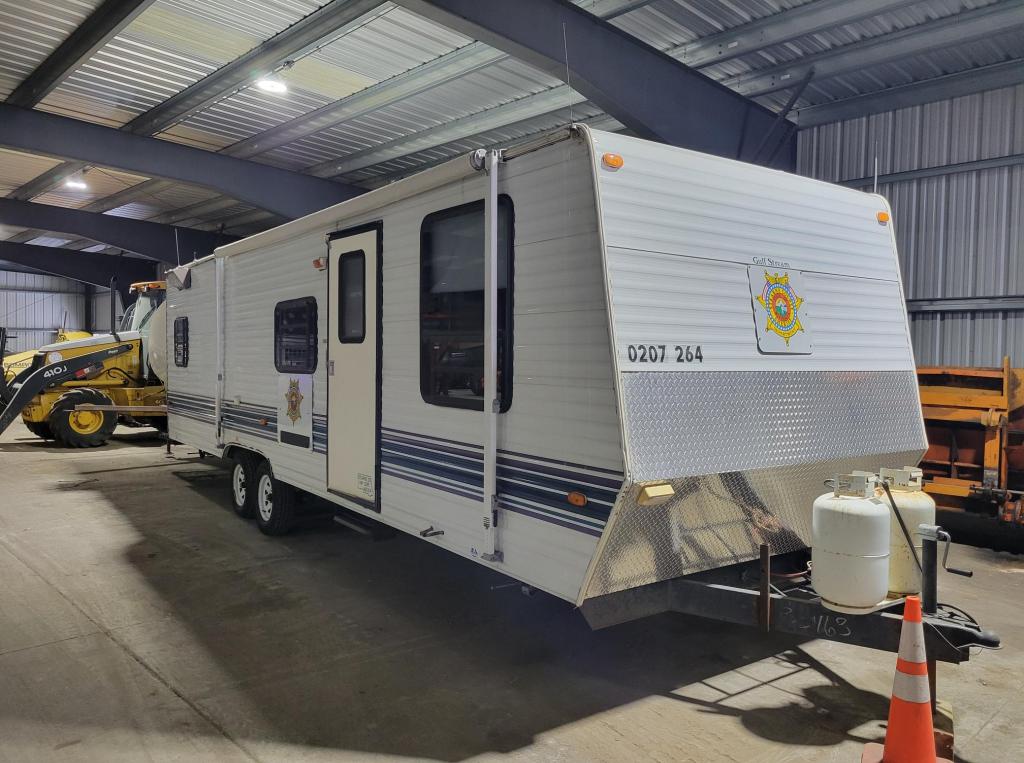
Interestingly, this was a former FEMA disaster housing trailer, about 29 feet. It was converted to a command trailer by a government agency. So the bathroom and plumbing were removed. This has one key advantage- nothing involving water has to be filled, emptied or in this cold climate, winterized. Ownership the trailer was suggested by me to be an ARRL Affiliated Ham Radio Club, which could be a legal entity and get insurance. One key question- how heavy was the trailer. The data tag was partially illegible, but the axles were rated at 3500 pounds each. The working theory was this would need a 3/4 to one ton pickup truck. It was towed by us 65 miles and was reported to be impacted by wind on the highway. We did spot and added a small 12V battery for electric brakes.
We got to peek at it. It has a large radio room with wrap around counters and a door in the nose. The center section has a large couch with storage under. The rear section has remnants of the kitchen and a dinette. Welded to the rear is an extension frame for a generator. The furnace was retained as was a rooftop RV air conditioning unit. The roof is aluminum thankfully not plastic or rubber. It was stored indoors and was not apparently leaking. There were about ten NMO antenna mounts on the edges of the roof. The AC power was to a 50 amp service entrance and a 50 amp RV cord/plug.
So the use case was for radio operators, GIS (Geographic Information Systems) operators, loggers and leadership. Rick Lyden, who ordered the trailer, asked us to take the couch out. This seems a no go, as random people (i.e. the Fire Chief) tent to show up and need a place to sit. A most used feature of the Hennepin County Sheriff Incident Communications center was the lovely 8 foot Couch.
Grant money appeared and radios were ordered. UHF/VHF dual band were the start, around three. We wanted a sprinkling of the Ham digital modes represented. Antennas (a series of NMO mounts) were present. We put in shelves for the radios. Rick wanted lots of curved screen monitors, also laptops. There was not counter space for both. We put the monitors on the wall over the radios.
In the far front was a half width space for an HF radio. Also at least one wall mounted 32 inch screen.
We needed a security system. We were just out of Wi Fi range of the storage provider. So we raced out and got a wireless LTE puck. That has Wi-Fi for the door and inside cameras. For remote deployment. we purchased, activated and paused a Starlink V3 dish. This has a Wi-Fi. The idea was out of 4G/LTE range, the puck would be unplugged. The battery door cameras and puck lived on a solar power system, with a 35AH gel battery and 50W panel and charge/load controller. Various motion operated lights were added.
For HF. we had two pipe mounts and 8′ pipes were added to those. A 2″ cable hole in the wall was located on one side, covered with a waterproof outlet. The Starlink cable and HF coax would go out that route. The Starlink dish was temporary- held on the roof with an Amazon canvas sandbag. The HF antenna was a vertical to sit on one of the two pipe mounts. A desktop computer /server was added. There was a map/badge capable printer on a home-made sturdy wooden platform.
Erik, NY9D
 Ham Radio Tower Trailers